
Earth’s magnetic shield is developing a strange weak zone that’s growing fast.

A mysterious region above the South Atlantic, where Earth’s magnetic field is weaker than anywhere else, has expanded dramatically in just a decade. Known as the South Atlantic Anomaly, it now stretches from South America toward Africa, covering an area nearly half the size of Europe.
Scientists say this anomaly is changing faster than expected — and what’s happening deep inside Earth may hold the key to understanding why.
1. The weak zone is putting satellites in danger.
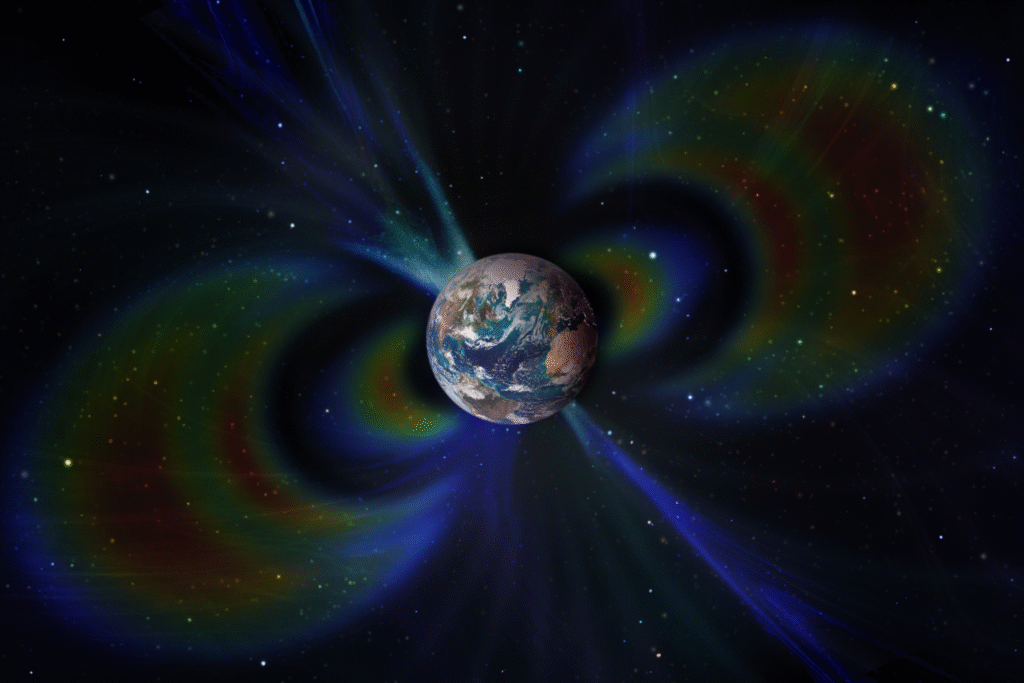
Satellites passing through the South Atlantic Anomaly are being bombarded with higher doses of radiation, often forcing operators to shut down sensitive instruments to avoid damage. The increased exposure can cause data corruption, navigation errors, and in rare cases, complete system failures. Space agencies now schedule operations around the anomaly’s location to minimize risk.
This radiation hotspot acts like a trap for charged particles from the solar wind. As the magnetic field weakens, those particles drift closer to Earth’s surface, turning this region into a hazard zone for anything that passes through orbit overhead.
2. Astronauts flying through it face health concerns.

When spacecraft like the International Space Station orbit through the anomaly, astronauts experience a surge in radiation exposure. Instruments often detect particle hits inside the cabin, which can interfere with onboard electronics and increase biological risk. It’s not immediately dangerous, but repeated exposure raises long-term health questions.
Scientists are studying how this radiation affects human tissue and how shielding can reduce the impact. The anomaly has essentially become an unavoidable checkpoint in low-Earth orbit — one that space agencies must factor into every mission.
3. The anomaly is shifting and splitting into two parts.

Recent data shows that the weak zone is not just expanding but also evolving into two distinct centers — one off the coast of South America and another southwest of Africa. The African branch, in particular, has been weakening more rapidly since 2020, puzzling researchers who once thought the anomaly was stable.
This splitting pattern suggests complex movements within Earth’s molten outer core. As iron flows and reverses direction deep underground, it reshapes magnetic field lines above, creating unpredictable new weak spots in the process.
4. The cause lies deep within Earth’s molten core.

At the heart of the planet, swirling liquid iron acts like a massive dynamo, generating the magnetic field that shields us from solar and cosmic radiation. But when those flows shift or reverse, they create “flux patches” — regions where magnetic field lines sink back toward the core instead of rising outward. That’s what’s happening beneath the South Atlantic.
These patches distort the magnetic shield in localized areas, reducing its strength and stability. It’s a natural process, but the speed of change has scientists wondering if larger magnetic shifts could be approaching.
5. Technology on Earth could feel the ripple effects.

While humans on the ground are safe from direct radiation, modern technology isn’t. The anomaly’s interference with satellites can affect GPS accuracy, weather forecasting, and communications. Even slight disruptions can ripple across industries that depend on orbital data, from aviation to emergency response systems.
As the anomaly grows, these disruptions could become more frequent. Engineers are already exploring stronger satellite shielding and adaptive software to detect and recover from radiation-induced errors.
6. Tracking satellites are offering a clearer picture.

The European Space Agency’s Swarm satellites have been mapping magnetic field fluctuations for nearly a decade, providing unprecedented insight into how the anomaly evolves. Data from these missions show that the field’s strength has dropped by more than 8% in the affected area since 2014 — a rapid decline by geological standards.
This continuous monitoring helps predict how the anomaly might change next. Without Swarm’s precise tracking, the expansion and splitting might have gone unnoticed until it began impacting more spacecraft and systems.
7. Some scientists think it could be a sign of a field reversal.

Earth’s magnetic field has flipped many times throughout history, with the north and south poles trading places. The last full reversal happened roughly 780,000 years ago. Some researchers believe the South Atlantic Anomaly could signal the early stages of another shift — though others warn it’s far too soon to tell.
If a reversal ever occurred, compass directions would change, and temporary weakening could expose satellites and power grids to greater radiation. For now, the anomaly remains a puzzle — one that scientists are racing to understand before it reshapes the invisible shield protecting our planet.